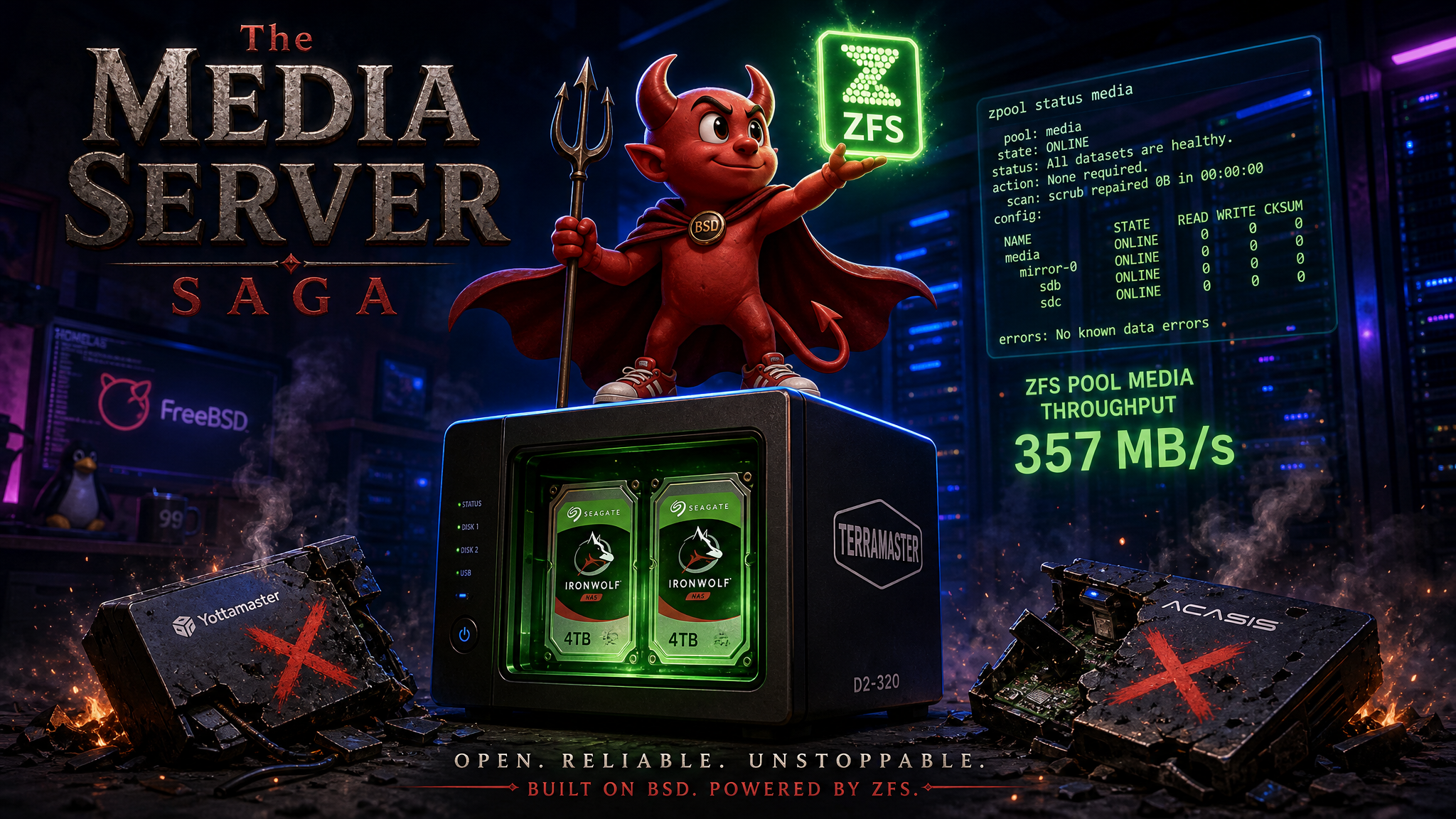
The idea was simple: give a second life to two battle-hardened Seagate IronWolf 2TB drives (with over 6 years of continuous uptime) as a high-speed Media Server. The chosen “brain” was a Mini PC running the rock-solid FreeBSD. All I needed was a Dual Bay USB 3.0 external enclosure (DAS) to connect the drives.
What I didn’t expect was that this simple premise would turn into a full-blown saga against haunted firmwares and terrible hardware quality — until I finally reached the perfect setup.
Chapter 1: The Curse of Cheap Hardware
Yottamaster: the chip that choked
My first attempt was with a Yottamaster enclosure. An absolute disaster. The ASMedia
chipset (ASM1352R) couldn’t handle the continuous I/O load from FreeBSD. Every slightly
heavier write attempt was met with dreadful CAM status error messages and USB
disconnections. The chip simply choked under stress.
ACASIS: the Zombie Bug
I returned it and tried my luck with another well-known Chinese brand: ACASIS. This time the danger was far greater — a genuine physical risk to the drives, in a scenario I dubbed the “Zombie Bug” (Zombie Sleep).
The main JMicron chip was fast, delivering an impressive 248 MB/s. But the thermal
management microcontroller was suicidal: when the enclosure entered hibernation mode and I
fired off a 150 GB rsync, the drives woke up and worked at 100% — but the board
forgot to spin up the exhaust fan and LEDs. The drives were being cooked inside the
aluminum shell.
I returned both. The lesson was harsh but clear:
Never trust your data to a “dumb” Chinese Hardware RAID microcontroller.
Chapter 2: The Definitive Hardware — TerraMaster D2-320
Exhausted from patching bad hardware, I decided to step up to the professional league: I imported a TerraMaster D2-320 chassis. Heavy, silent, built to last — with an industrial-grade power supply (KPTEC Tier 2) and a real thermally-controlled fan (Smart Fan).
The golden rule I applied: the TerraMaster has a physical Hardware RAID switch on the back. I ignored the Hardware RAID. I flipped the switch to “Single” (JBOD / independent disks mode). This creates a “dumb bridge” (passthrough) and hands full control over to FreeBSD.
Chapter 3: The Glory of Passthrough and S.M.A.R.T.
As soon as I plugged the TerraMaster into the Mini PC — on the rear USB 3.1 port, to
avoid any front panel interference — the FreeBSD syslog smiled back at me:
uhub2: <TerraMaster 4-Port USB 3.2 Hub, class 9/0, rev 3.20/1.73, addr 4> on usbus0
umass1: <TerraMaster TDAS, class 0/0, rev 3.10/1.00, addr 5> on usbus0
umass1:  SCSI over Bulk-Only; quirks = 0x0000
da1: <TerraMas TDAS 0> Fixed Direct Access SPC-4 SCSI device
da2: <TerraMas TDAS 0> Fixed Direct Access SPC-4 SCSI device
Notice the magic detail: quirks = 0x0000. The kernel didn’t need to apply any obscure
workaround. The SCSI/USB communication was native and perfectly clean.
Running smartctl -a /dev/da1 was the final confirmation. Not only were the native health
metrics fully accessible, but the thermal readings attested to the enclosure’s physical
excellence:
194 Temperature_Celsius: 26   (Drive 1)
194 Temperature_Celsius: 28   (Drive 2)
Chapter 4: ZFS and Supersonic Speed
Perfect hardware, cooling under control. Time for the software to shine. Leveraging the multicore power of the Mini PC and the kernel’s advanced algorithms — instead of an overheating Chinese chip — I unified both veteran drives into a ZFS Stripe pool (software RAID 0). The result speaks for itself:
# dd if=/dev/zero of=/usb1/teste_disco.img bs=1M count=20480 status=progress
21474836480 bytes transferred in 60.082986 secs (357419596 bytes/sec)
# zpool status usb1
  pool: usb1
 state: ONLINE
config:
        NAME          STATE     READ WRITE CKSUM
        usb1          ONLINE       0     0     0
          gpt/usb1-1  ONLINE       0     0     0
          gpt/usb1-2  ONLINE       0     0     0
357 MB/s. FreeBSD and the TerraMaster extracting 100% of the combined theoretical throughput of the 5900 RPM IronWolf drives. Zero loss on the cable, zero loss on the chip.
Conclusion
After stumbling over problematic USB bridges, I learned that under heavy FreeBSD workloads, there are no cheap shortcuts. Combining reliable hardware (TerraMaster + KPTEC PSU + Seagate IronWolf) with transparent JBOD mode and the invincible ZFS is the Holy Grail of a true Homelab setup.
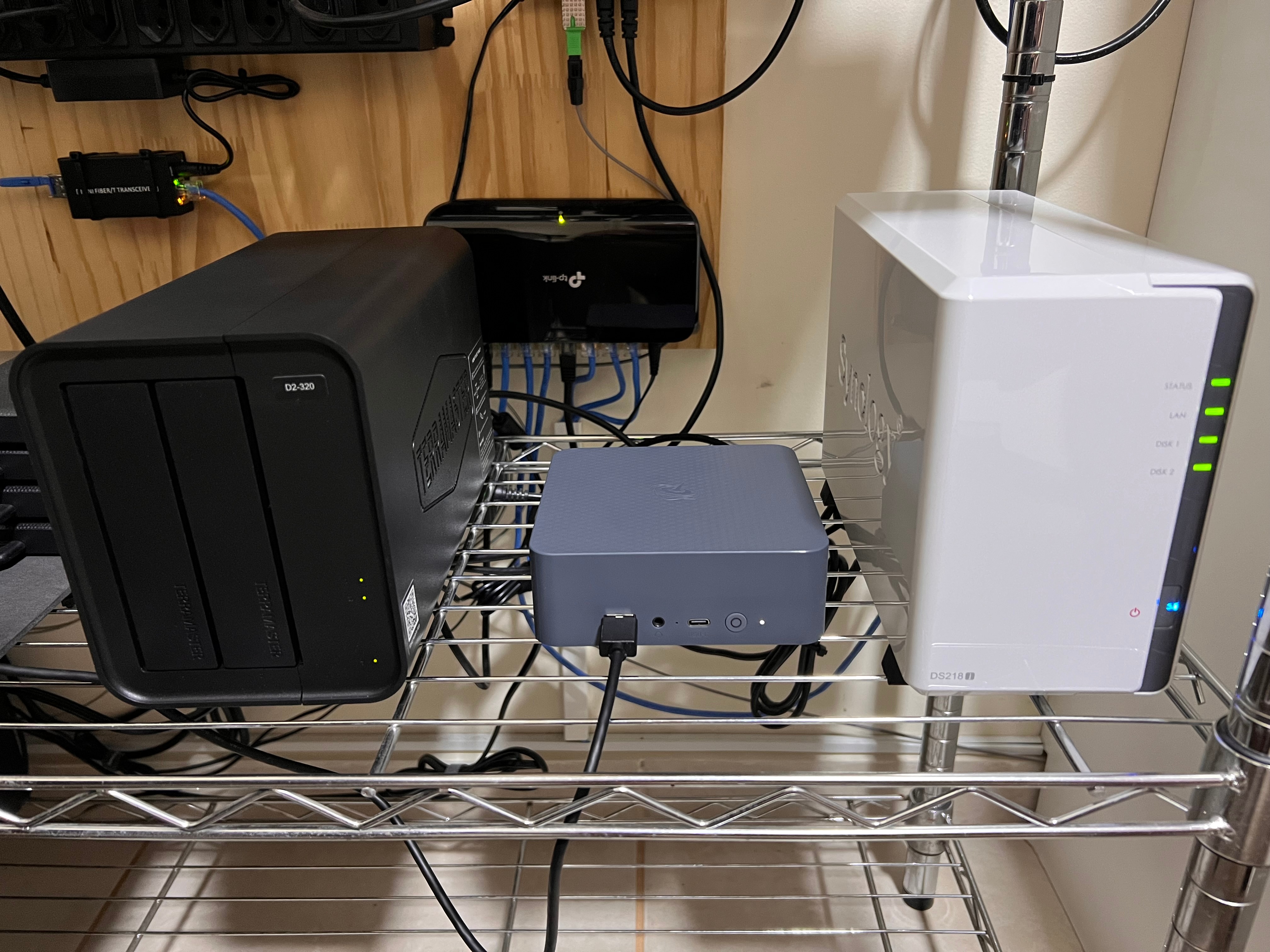
The final setup, with the TerraMaster D2-320 connected to the Mini PC, and the Synology DS218+: